Thursday, November 27, 2014
Japanese Corporation Plans to Turn the Moon Into a Massive Solar Power Plant
Man hasn’t been back to the moon since 1972, but that hasn’t stopped a team of Japanese engineers from developing a plan to turn our celestial neighbor into a massive solar power plant. The disaster at the Fukushima nuclear power station has made Japan think more seriously about alternative energy, and as a result Shimizu Corporation‘s crazy plan has been gaining traction. The plan calls for a massive 12 mile-wide, 6,800 mile long “Luna Ring” of solar panels to be constructed on the moon’s surface. The solar belt would then harness solar power directly from the sun and then beam it straight to Earth via microwaves and lasers.
Shimizu Corporation’s plan would see 13,000 terawatts of continuous energy sent to receiving stations around the Earth, where it will be then distributed to the planet’s population. With NASA’s plans to return the moon currently on hold, Shimizu is planning on building the massive lunar construction project with robots. In fact, humans will barely be involved and will only be present in an overseeing capacity.


When the rivers run black
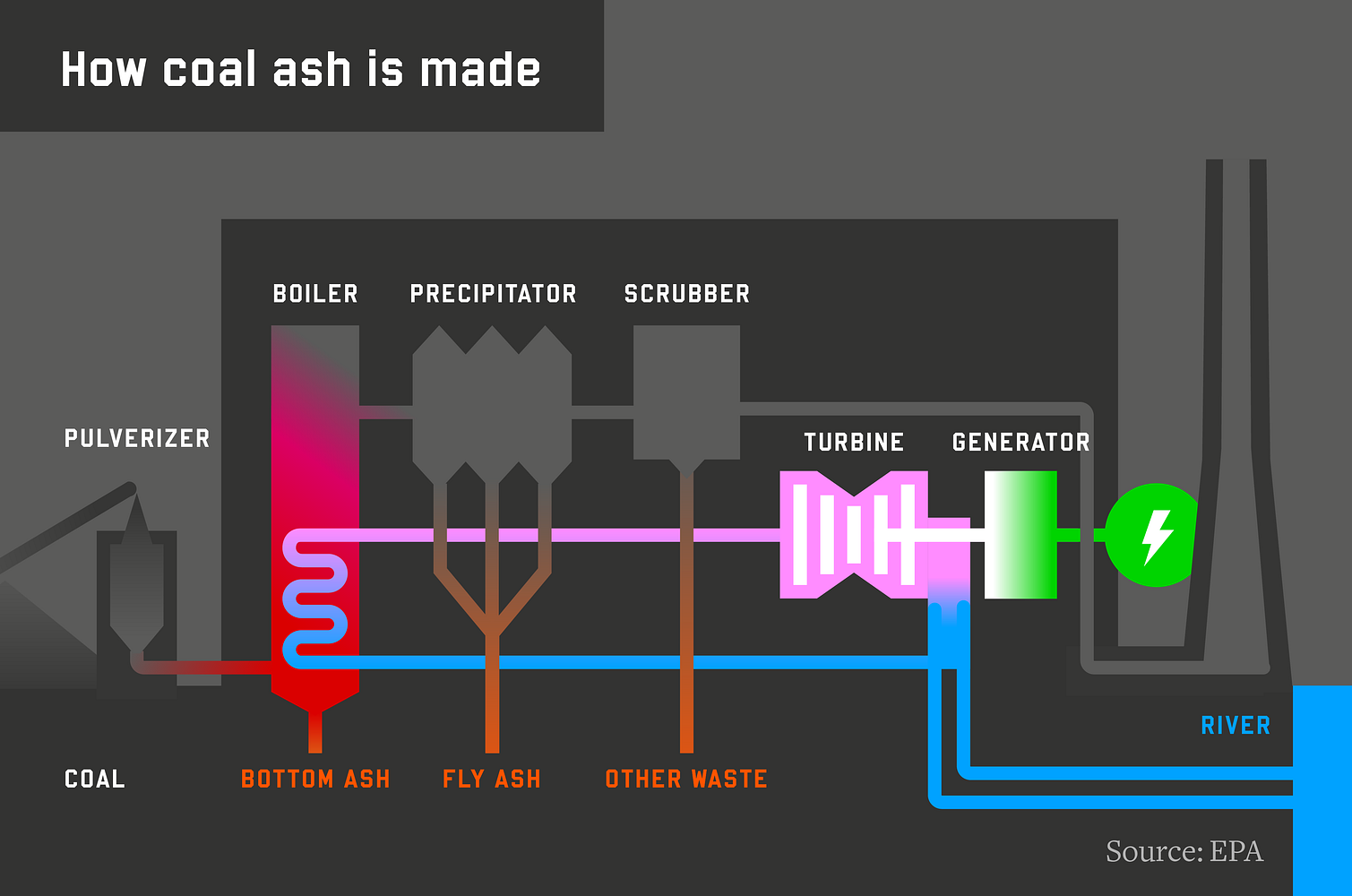
The most toxic byproduct of coal-fired power isn’t carbon dioxide. It’s the residue that’s left over. When coal is burned in a plant, just like in a home, it produces two kinds of ash: fly ash, which rises, and bottom ash, which sinks to the floor of the furnace. Together, they comprise coal ash. In a power plant, all that ash has to be put somewhere.For many years Kingston was the largest coal plant in the United States, which meant the facility produced a lot of coal ash. It was mixed with water to stop it from blowing around and dumped into the retaining pond, which quickly swelled with the waste. As the region grew, demand for electricity soared, more coal was burned, and the TVA built the walls of the pond higher and higher. By 2008, they stood 60 feet tall, and the pond held more than a billion gallons of coal ash slurry.
Shortly before 1 A.M. on December 22, 2008, the walls broke.
One corner of the dike, exhausted after a half-century of pressure and decay, collapsed. The coal ash sludge poured out, tearing a hole that kept on growing. Once outside, the slurry built up force and barreled over a sequence of outer dikes. ...
The TVA is the largest public power provider in the country, serving nine million people across seven states.
Like many other power companies, it has slowly been expanding its energy portfolio, but coal remains its backbone. And, like the rest, it has been upgrading that infrastructure, forced by the Environmental Protection Agency to make its plants run cleaner and more efficiently. Usually, that means installing scrubber systems in the smokestacks, which clean the emissions of pollutants like mercury, toxic metals, and acid-rain-causing sulfur dioxide.
The result is that the exhaust that emerges today is far cleaner than it was decades ago. But cleaning up the airborne emissions means that the solids remaining after the burn are far dirtier than before. In fact, coal ash is often loaded with arsenic, mercury, lead, and other contaminating elements. A 2012 study published in the journal Environmental Science & Technology found that cleaner air emissions are traded for “significant enrichments of contaminants in solid wastes and wastewater discharged from power plants.”
According to the American Coal Ash Association, the nation churns out nearly 65 million tons of coal ash annually. However, despite the fact that it is replete with toxins, coal ash is essentially unregulated by the federal government, with oversight meant to happen at state level. Yet most states handle the material with less precaution than your standard household garbage.
The “best” use for coal ash, say scientists, is to recycle it and use it in cement, which means the contaminants get locked in and cannot leach out. But there are a range of other recycling methods, including using it in asphalt and wallboard, spreading it as a soil amendment, or using it as a substitute for salt on icy roads. One particularly novel method of disposal is dumping it into abandoned mines. Most coal ash, though, is simply carted off to landfills or placed in retaining ponds like the one at Kingston. Many of the ponds, including Kingston’s failed one, are not just built to contain the coal ash, but actually use it as a construction material in their dams and dikes.
In Kingston, it was the dike that broke, but spills and contamination can happen in all kinds of ways. In 2005, a log wall broke in a basin at a Pennsylvania power plant, spilling at least 100 million gallons of coal ash into the Oughoughton Creek and Delaware River. In October 2011, a bluff at a Wisconsin power plant collapsed, spilling coal ash into Lake Michigan.
Environmental groups dislike pond storage, arguing that wet ash is more likely to leach contaminants into nearby water supplies, as well as being a far greater risk for catastrophic spills. A draft EPA risk assessment released in 2010 showed that coal ash ponds pose greater risk to human health due to leaching than landfills.
Charles Norris of Geo-Hydro Inc, a scientist from Denver who has testified before Congress on the subject of coal ash, says things are made even worse by using it as a construction material. Not only does this let even more contaminants leach out, but over time it compromises the structural integrity of the pond. Kingston, Norris believes, is unlikely to be the last incident of its kind. “The use of this as a construction material is new enough that we’re probably just looking at the beginning few failures,” he says.
The storm blows in the crazies to GOP land
Tossed palms at the street corners, the fraying and fading porches of Californian bungalows stretching back for kilometres, a low grey sky, and a foul tropical wind … St Petersburg has seen better days.The city across the bay from Tampa was a product of the Florida land boom of the ’20s, sprawling across the peninsula, grid block after grid block. The boom laid down houses in their tens of thousands, bungalows with Japanese-style roofs and stone pillars, suggesting a new order of healthful nature, exotica, painted yellows and pinks and browns. Shops and garages at each corner, in art deco style — curved lines like cruise liners and seaplane wings, round windows, cherry-red light fittings, the streamlined and moderne, the past’s idea of the future. The city was the place to be in the ’20s. Then the Depression hit, and it’s been going quietly downhill ever since.
Some bungalows have been lovingly restored; others, houses that would give no change from a cool million in Melbourne or Sydney, rot away in the sea air. The shops on the boulevard have long glass display frontages, half-empty, or crowded with faded haberdashery and handicrafts. They make one tired merely by looking at them. At every intersection, they’ve punched in a shopping centre of the current style — dull-brown, slab-tilt, every sign — Walmart, Goodwill, Payless Shoes — general issue, undifferentiated, monopoly capital leaching away the sole virtue of the market, its exuberance. People drive up and haul away, as if at depots.
Today it’s bottled water. They’re coming out of the Walmart, loaded into carts, on palettes, going into the back of SUVs. The shelves near the registers are cleared of batteries, and torches are gone. Hurricane Isaac is coming, has hit the Florida Keys by now, and cities to the north are battening down. Tampa has already been entirely disrupted for the convention, the city criss-crossed with street-closures, concrete bollards pulled across, cyclone fencing around police stations. Casualty departments have been rehearsing decontamination scenarios. Everything has been oriented to the big gig at the Tampa Bay Times Forum, the hot centre of the city for three days.
In Tropicana Field, St Petersburg’s forlorn sports stadium, the opening party of the convention is going ahead tonight, but the convention proper has been put back a day to start Tuesday, in case Isaac — currently heading towards New Orleans — adopts the style of the moment and takes a sudden right turn and hits us with full force two. Delicious irony.
Should the Republicans fail to gain Florida — and hence lose the election — it will be because the Democrats managed to turn out the Jewish vote on the east coast. Was someone in the National Weather Service having a sly laugh when they named it such? Why did they not simply call it Barack and have done with it?
Last time the Republicans gathered, in the unlikely province of St Paul, Minnesota, they were pumped. The Democrats had held their convention, but they’d lost the news cycle almost immediately as the Republicans had announced their vice-presidential choice the day after, and Sarah Palin had set the country aflame, for a moment trumping the Obamamania. The financial crisis had not yet hit, and John McCain had not yet made a fool of himself by announcing that he was suspending his campaign and returning to Washington to sort it all out. Palin had not yet been, well, Sarah Palin, and the tales of a frontier state governor who could shoot a moose, and sold the governor’s jet on eBay had sent a shiver up the backs of the great and good.
That was a long long time ago, and the part is older and a little wiser, at least as far as VP choice is concerned. They have as their candidate Mitt Romney, a man who excites no one, not even Mitt Romney. To appease the base, but purportedly avoid the bad craziness of the Palin trip, they have chosen Paul Ryan, a thoroughly competent, highly intelligent, utterly lunatic Ayn Randian manorexic from Wisconsin. That may or may not work — Ryan has already been implicated in the Todd Akin “r-pe doesn’t cause pregnancy” scandal. Nevertheless, he’s not the type to say that he understands NAFTA because he can see Canada from Milwaukee, and that’s why he’s there.
But that doesn’t make for much of a party, and the gathering at Tropicana was, well, not subdued — the Republicans are too batshit crazy to be subdued — but lacking a certain genuine zest of yesteryear. “I cannot believe that the American people will re-elect a man who knows nothing about what America is,” said Jim, a huge man, near spherical, in a blue blazer and tan slacks. He was from Iowa, from whose name he removed the sole vowel, rendering it as “Ow”, like a cry of pain. He was angry with the media, which had been grudgingly admitted. His wife, Maeve, a delicately boned woman in a lace dress, was more conciliatory.
“You’re from Australia? Do you know about Barack Obama and what’s he done?” She peeked out from behind her husband, orbiting him like a moon. Did they think Romney would win? “Yessir, but it’s a battle,” said Jim. Maeve: “What with the liberal media …”
They had no doubt that Romney would win, but there was no swagger in their voice. In 2008, they could not believe that Obama would win. Hardly an extreme judgement — after all, in early 2008, the Democrats didn’t believe that Obama could win. Now that he was the President, that fact was a little harder to ignore. They had a candidate they liked better than John McCain, who had troubling inclinations towards bipartisanship, and a veep candidate they loved, a man who wanted to reduce government share of GDP spending to 3.75% (from around 24%, itself one of the lowest figures in the OECD).
Yet they had no air about them that commonsense and sanity would be restored. They were waiting to find out what their country would become — or in their minds, if it would exist at all after January 2013.The feeling spread across the vast St Petersburg-Tampa conurbation today, for over at the other corner, at the University of South Florida, Ron Paul was holding a one-day counter-convention, a second instalment on the “Paulapalooza” event he had held in Minneapolis in ‘08. This one was a little more subdued, if only because, in true form, there had been a split in the Ron Paul forces — with his more outre group staging a two-day “Festival of Paul” beforehand, at the fairgrounds, in which radical right-wing libertarianism mingled with heavy metal and the hardcore paranoia of the John Birch Society.
Paul skipped the fairgrounds fiasco — showing a circumspection he has not always displayed — and the split was significant, for it showed that the weird mix of boring Austrian economics and counter-cultural brouhaha that Paul’s supporters had pioneered, was coming apart at the seams. The crazies and the comb-overs were drifting back apart.
Paul himself is retiring, and his son Rand, a Kentucky senator, is taking over the family franchise. But he has nothing of Paul’s wiry charisma, and he is angling for a long career at the heart of the Republican Party, so he is toning down the one thing that has given the movement a broad appeal — Ron Paul’s uncompromising opposition to foreign adventures, and a US empire. Whether the Republicans win or lose in November, the Paul movement has peaked, and has started to fade.
Should the party win, many Paulites will happily fold into a fudged-up right-wing Romney era, satisfied that they have seen off an alien presence. The others will simply spin off into space, or into whatever bizarre movement endtimes American culture can come up with next.
But one way or another, the storm is coming in. You come out of an air-conditioned building, feeling like an iceberg lettuce, and into the hot wind twisting between the bungalows. There will be no relief, even should the storm come. The heat will not break, and so the whole city is held in suspension, but with no suggestion of what might end it, of what could.
Or of what would stop the slow wearing away, the flaking of paint, the salt air eating into the frame, that is now so all-pervasive in America as to be barely recognised.
Wednesday, November 26, 2014
How Poverty Taxes the Brain
This understanding of the brain’s bandwidth could fundamentally change the way we think about poverty. Researchers publishing some groundbreaking findings today in the journal Science have concluded that poverty imposes such a massive cognitive load on the poor that they have little bandwidth left over to do many of the things that might lift them out of poverty – like go to night school, or search for a new job, or even remember to pay bills on time.In a series of experiments run by researchers at Princeton, Harvard, and the University of Warwick, low-income people who were primed to think about financial problems performed poorly on a series of cognition tests, saddled with a mental load that was the equivalent of losing an entire night’s sleep. Put another way, the condition of poverty imposed a mental burden akin to losing 13 IQ points, or comparable to the cognitive difference that’s been observed between chronic alcoholics and normal adults.

Monday, October 27, 2014
What the IPCC found The big news from the new climate assessment
It’s extremely likely that humans have been the dominant cause of global warming since the 1950s, according to a landmark report from the world’s top panel of climate scientists. And we’re failing in our efforts to keep atmospheric warming below 2 degrees Celsius, or 3.6 Fahrenheit, which many scientists say is needed to avoid massive disruption.The Intergovernmental Panel on Climate Change conducted an epic review of climate research over the last three years. It is summarizing the most important findings in its fifth assessment report, which offers the clearest picture science has ever painted of how humans are reshaping the climate and the planet.
Here, in a nutshell, are the main findings of a summary [PDF] of part one of the assessment report, which focuses on the science of climate change:
Human influence has been detected in warming of the atmosphere and the ocean, in changes in the global water cycle, in reductions in snow and ice, in global mean sea level rise, and in changes in some climate extremes. … Warming of the climate system is unequivocal, and since the 1950s, many of the observed changes are unprecedented over decades to millennia.


Sunday, October 26, 2014
The bright future of solar powered factories
A large share of energy consumed worldwide is by heat. Cooking, space heating and water heating dominate domestic energy consumption. In the UK, these activities account for 85 percent of domestic energy use, in Europe for 89 percent and in the USA for 61 percent (excluding cooking).
Heat also dominates industrial energy consumption. In the UK, 76 percent of industrial energy consumption is heat. In Europe, this is 67 percent. I could not find figures for the US and for the world as a whole, but these percentages must be similar (and probably even higher on a worldwide scale because many energy-intensive industries have been outsourced to developing countries). Few things can be manufactured without heat. ...
The missing element in our sustainable energy strategy is a renewable source of thermal energy. Geothermal energy produces heat, but its potential is limited to regions that have volcanoes. Biomass is another option, but it faces many problems. If we were to try to provide an important share of heat demand by burning biomass, we would quickly come up against the limits of what the planet can produce. There is only one source of heat energy left, and it is a powerful and inexhaustible one: solar energy.
We tend to see solar energy as yet another way to generate electricity, using photovoltaic panels or solar thermal power plants. But solar energy can also be applied directly, without the intermediate step of generating electricity. Basically, harvesting direct solar energy can happen in two ways: by means of water-based flat plate collectors or evacuated tube collectors, which collect solar radiation from all directions and can reach temperatures of 120 °C (248 °F), and by means of solar concentrator collectors, which track the sun, concentrate its radiation, and can generate much higher temperatures. These can be parabolic trough systems, linear concentrating Fresnel collectors, parabolic dish systems or solar power towers. Almost all of these technologies were developed at the turn of the 20th century.
Solar thermal power versus solar thermal heat
Solar power tower The problem is that we mostly use this technology for the wrong purpose. In todays solar thermal plants, solar energy is converted into steam (via a steam boiler), which is then converted into electricity (via a steam turbine that drives an electric generator).
This process is just as inefficient as converting electricity into heat: two-thirds of energy gets lost when converted from steam to electricity. This is one of the main reasons why the use of solar thermal energy to produce electricity is only cost-effective in deserts. ...
If we were to use solar thermal plants to generate heat instead of converting this heat into electricity, the technology could deliver energy 3 times cheaper than it does today and become cost-effective also in less sunny regions. The crucial difference between solar thermal electricity and other renewables producing electricity is that solar thermal actually starts with heat energy. Thus, contrary to other renewables, the cost of heat energy using the technology is far lower than the cost of electricity, and so it can compete with burning fossil fuels at the thermal level. ...
Without a doubt, solar heat for domestic purposes should continue to be encouraged and a lot of potential remains. But it does not stop there. According to a 2008 report (pdf), which analyses the situation in Europe, the potential for solar heat in industrial processes is even larger than in the domestic market. About 30 percent of industrial heat demand in Europe is below 100 °C (212 °F), which could be delivered by commercially available flat plate collectors (< 80 °C) and evacuated tube collectors (< 120 °C) currently used for domestic purposes.
Another 27 percent of industrial heat demand requires medium temperatures (100 to 400 °C or 212 to 752 °F), which could be reached by improved versions of these collectors (up to 160 °C, see this document) and by commercially available solar concentrator technologies now mostly used for electricity production: parabolic troughs, parabolic dishes and linear concentrating Fresnel collectors.

The Death Of Peak Oil
Peak oil hasn’t happened, and it’s unlikely to happen for a very long time. A report by the oil executive Leonardo Maugeri, published by Harvard University, provides compelling evidence that a new oil boom has begun(9). The constraints on oil supply over the past ten years appear to have had more to do with money than geology. The low prices before 2003 had discouraged investors from developing difficult fields. The high prices of the past few years have changed that.Maugeris article referenced by Monbiot has garnered a lot of attention lately but it didnt appear to say anything new. The shale oil boom does exist but the volumes are still trifling compared to US oil consumption, let alone global oil consumption and this is exactly what youd expect to see - using technology to exploit (expensive and dirty) unconventional oil reserves as production of conventional oil sources peaks.Maugeri’s analysis of projects in 23 countries suggests that global oil supplies are likely to rise by a net 17m barrels per day (to 110m) by 2020. This, he says, is “the largest potential addition to the world’s oil supply capacity since the 1980s.” The investments required to make this boom happen depend on a long-term price of $70 a barrel. The current cost of Brent crude is $95(10). Money is now flooding into new oil: a trillion dollars was spent over the past two years, a record $600bn is lined up for 2012(11).
The country in which production is likely to rise furthest is Iraq, into which multinational companies are now sinking their money, and their claws. The bigger surprise is that the other great boom is likely to happen in the US. Hubbert’s Peak, the famous bell-shaped graph depicting the rise and fall of US oil, is set to become Hubbert’s Rollercoaster.
Investment there will concentrate on unconventional oil, especially shale oil (which, confusingly, is not the same as oil shale). Shale oil is high-quality crude trapped in rocks through which it doesn’t flow naturally. There are, we now know, monstrous deposits in the United States: one estimate suggests that the Bakken shales in North Dakota contain almost as much oil as Saudi Arabia (though less of it is extractable)(12). And this is one of 20 such formations in the US. Extracting shale oil requires horizontal drilling and fracking: a combination of high prices and technological refinements has made them economically viable. Already production in North Dakota has risen from 100,000 barrels a day in 2005 to 550,000 this January (13).
So this is where we are. The automatic correction – resource depletion destroying the machine that was driving it – that many environmentalists foresaw is not going to happen. The problem we face is not that there is too little oil, but that there is too much.
We have confused threats to the living planet with threats to industrial civilisation. They are not, in the first instance, the same thing. Industry and consumer capitalism, powered by abundant oil supplies, are more resilient than many of the natural systems they threaten. The great profusion of life in the past – fossilised in the form of flammable carbon – now jeopardises the great profusion of life in the present.
There is enough oil in the ground to deepfry the lot of us, and no obvious means by which we might prevail upon governments and industry to leave it in the ground. Twenty years of efforts to prevent climate breakdown through moral persuasion have failed, with the collapse of the multilateral process at Rio de Janeiro last month. The world’s most powerful nation is once again becoming an oil state, and if the political transformation of its northern neighbour is anything to go by(14,15), the results will not be pretty.


The other big potential jump in oil production comes from Iraq which isnt exactly news - its been obvious to anyone who has researched the history of the country that this is the one massive source of conventional oil which hasnt really been tapped - however this is not enough to invalidate peak oil theory nor will it make decades of difference to the global peak point.
The brouhaha over this reminds me a bit of an earlier episode this year, started by a report from Citibank and fanned by the likes of Alan Kohler, predicting "the death of peak oil" which was notable for its confusing of gas with oil and a complete absence of numbers (not to mention claiming large reserves of shale gas in places like Poland where it has been proven to not be the case).
Chris Nelder had a good critique of this episode - Energy independence, or impending oil shocks? (Matt Mushalik also weighed in with a relatively restrained - for him - piece - No number crunching in Alan Kohler opinion piece on premature peak oil death).
Cane toads of the air thrive on stupidity
Im always amazed by how readily we let our buttons be pushed. Its almost as though we want them to manipulate us. As though we like it. "Them", here, obviously includes politicians, advertisers and spin merchants, but the worst offenders, partly because theyre the least explicit, are "shock jocks".
They are the cane toads of contemporary culture: ugly, ubiquitous, toxic to most other life forms and adept at using their peculiar behaviour to force change in ours.
Its not so much that theyre rude, lowbrow or just plain wrong, although these, too, are often the case. The most destructive effect of the shock-jockariat is the poisoning of the logic-well itself; followed by the incremental death of the argument tree that is root and branch of intelligent civilisation. ...
Take Alan Jones. Though it pains me to say it, he is forcing me to change my mind. Not on climate change, or cycling, or the right to public protest, all of which he opposes, but on censorship.
Foucault argued that unreason died with the enlightenment. But the shock-jock phenomenon proves repeatedly that if you make an argument sufficiently idiotic, the sheer scale of stupidity makes it hard to defeat. It was highlighted for me this week by a letter that argued, as Jones does, that anything so small as 0.04 per cent - the proportion of CO2 in the atmosphere - couldnt possibly matter. "Please let me know," concluded my correspondent, "how anyone could believe that CO2 is responsible for climate change?"
Its like arguing that a virus is too small to give you AIDS. Or that a lethal dose of heroin, at about 0.0007 per cent of your body weight, couldnt possibly kill.
Never mind that applying the same logic to asylum seekers would make you wonder what all the fuss was about (our total asylum applications - 8150 last year, including dependants - being a mere 0.04 per cent of the population.)
These climate-change rants deliberately ignore everything about eco-balance, homeostasis, the greenhouse effect and tipping points weve all been taught since primary school and instead raucously promote a red herring.
Why do politicians tolerate it? Why do we? My theory is this. Most shock jocks, and their audiences, are pretty long in the tooth. Perhaps theres just a certain kind of person who, as the hormones start to recede, needs this pseudo-emotion to feel alive.
Thursday, October 23, 2014
Misunderstanding The Limits To Growth
Paddy Manning at Crikey has an article both outlining a recent example and being one itself, as Paddy infuriatingly describes "Limits" as making a forecast rather than what it actually did - which was describe a set of scenarios based on a range of assumptions - Beware Hugh Morgan and the climate sceptic zombie attack!.
If Hugh Morgan is saying it, it must be wrong.Recall the businessman’s previous campaign against the High Court’s Mabo decision — which extended to a defence of terra nullius and warnings that Australia’s territorial integrity was under threat — or his glowing 2010 endorsement of the young Australian Workers’ Union boss Paul Howes as a future Labor leader, after his starring role unseating a first-term prime minister.
And so it was again yesterday with Morgan’s declaration in an interview with The Australian that the Intergovernmental Panel on Climate Change would be remembered as a “Chicken Little”, like the Club of Rome.
Morgan is a long-time president of the climate sceptic Lavoisier Group and was a member of the Business Advisory Council on Climate Policy, established in May 2011 by then-shadow environment spokesman Greg Hunt. (Did they meet often, I wonder, in their quest for a non-policy to solve a non-problem? Does it matter?)
Morgan told the Oz that the 1972 book The Limits to Growth, based on research by a team of scientists from MIT (not mainly European, as the article states), “illustrates the dangers of academics talking about things they know nothing about”:
“‘The IPCC will be remembered in the same way as the Club of Rome for its “Chicken Little” approach.’ “Mr Morgan said political leaders should reread The Limits of Growth to understand the dangers of modelling and the risk of believing ‘academics who think they can see the future’.“He said the Club of Rome’s prediction that most major commodities would run out within a few decades had been proven wrong because of the scientists’ failure to consider technological innovation in the resources industry and their inability to understand how companies made decisions. “‘It completely presumed there was a standstill in technology,’ Mr Morgan said.
It is hardly worth attacking Morgan, who is entitled to his opinion, and good luck to him. But it is definitely worth defending the Club of Rome against such repeated misrepresentation, which crops up too often.
Published in 1972, Limits to Growth was the most popular environment book in history, selling 30 million copies in 30 languages.
In 2008 and 2012 CSIRO research scientist Graham Turner looked at how the real world was tracking, using three and then four decades of historical data, against the business-as-usual scenario outlined in Limits to Growth, which forecast the collapse of the environment, the global economy and subsequently the population, in mid-century. The answer is: we’re on track — the data matches “surprisingly closely” (Turner outlines this well in a seven-minute podcast). He takes on the critics of Limits to Growth for misrepresenting the modelling:
“Many asserted, falsely as it turns out, that the Limits to Growth predicted we would have run out of resources by 2000 and the economy would have collapsed by then, so they then say that the Limits to Growth was wrong. This turns out not to be the case. The Limits to Growth never said that at all.”
Heres one of the scenarios from "Limits" - note the absence of doom in this one (and the underlying assumption that technology does indeed progress)...

Hubble Image Showcases Star Birth in M83 the Southern Pinwheel
The spectacular new camera installed on NASAs Hubble Space Telescope during Servicing Mission 4 in May has delivered the most detailed view of star birth in the graceful, curving arms of the nearby spiral galaxy M83.
Nicknamed the Southern Pinwheel, M83 is undergoing more rapid star formation than our own Milky Way galaxy, especially in its nucleus. The sharp "eye" of the Wide Field Camera 3 (WFC3) has captured hundreds of young star clusters, ancient swarms of globular star clusters, and hundreds of thousands of individual stars, mostly blue supergiants and red supergiants.

M83 – click for 995×1000 image
More: here, here
Wednesday, October 22, 2014
Coal is still the most important source of U S electricity
The Economist on 3D Printing
In a monthly column he writes about his motoring passion for Popular Mechanics, Mr Leno recently described how his “Big Dog Garage Team” fabricated a feedwater heater for his 1907 White Steamer. The aluminium part had become so porous with age that steam could be seen seeping through. Being heavily impregnated with oil, patching it up by welding a plate in place was impossible. The answer was to fabricate the part anew.
First, they used a 3D scanner to create a detailed digital model of the part at 160,000 dots per inch. Next, they fed that model to a 3D printer, which used the file to print, layer by layer, an exact copy of the part in plastic. Finally, the replica part made of plastic was used to make a mould for casting the finished component in aluminium. The scanning was a breeze, but printing the part took 33 hours. Still, having the item sent out for drawings to be made and then the part machined from solid metal would have taken weeks.
As might be expected, Mr Leno’s tools are among the best available—a $3,000 scanner from NextEngine and a $15,000 printer from Dimension, not to mention a Fadel CNC machining centre, which must have cost upwards of $100,000. Apart from a hydraulic lift and a plentiful supply of compressed air, your correspondent’s humble workshop has nothing to compare. But his three old cars present similar problems.
The good news is that the kind of rapid-prototyping technology used in the motor, aerospace and medical industries (not to mention Mr Leno’s garage) has fallen in price dramatically over the past few years. While an industrial 3D printer (also known as a fabricator or a rapid prototyper) would once have cost over $100,000, a perfectly adequate machine for home use can now be had for less than $2,000. Those prepared to assemble their own can buy kits for $500 or so.
There are drawbacks, of course. The size of products that can be made using a desktop 3D printer is usually limited to something that can fit within a five-inch (12.7cm) cube. Industrial fabrication machines can make parts six times larger. Even so, a desktop 3D printer will suffice for a surprising number of components used in cars and around the home.
As a manufacturing process, 3D printing is what is known as an “additive” technology. Instead of removing material wastefully (by milling, boring, grinding and cutting), 3D printing uses what is effectively a modified ink-jet printer to deposit successive layers of material until the three-dimensional object is built up completely, with very little scrap. The material used is usually a thermoplastic such as ABS (acrylonitrile butadiene styrene), polylactic acid or polycarbonate, though metallic powders, clays and even living cells can be employed, depending on the application.
While some hobbyists download ready-made designs to fabricate, many users create their own engineering drawings by taking advantage of free software like Google’s SketchUp or Blender from the Blender Foundation in the Netherlands. For a price, professional packages can be had from Alibre Design, Autodesk and SolidWorks. Once the drawing is finished, the file is saved in a format the 3D printer recognises. On being loaded into the printer, the devices built in software analyses the digital design and works out the optimal way to trace the successive layers of the product being fabricated.
The grandaddy of all desktop 3D-printers is the open-source RepRap project conceived in 2005 by Adrian Bowyer and colleagues at the University of Bath, in Britain. The RepRap (short for Replicating Rapid Prototyper) concept’s main purpose is to make a machine that can replicate itself and evolve in the process. To date, three generations of reference designs have been released into the wild, each named after a famous biologist (Darwin, Mendel and Huxley). RepRaps are now reproducing around the world like rabbits.
The aim is to enable people—especially those in poorer parts of the planet—to make complex products for themselves without the need for industrial infrastructure and heavy capital investment. As an open-source project, anyone is free to use the design and improve it, so long as they make their additions freely available to others.
The personal-manufacturing movement—exemplified by Thingiverse for sharing user-created 3D files and Fab@Home to exchange ideas about hardware and software—resembles nothing so much as the era when the MITS Altair 8800 kit, with its eight-bit Intel processor and S-100 bus, prepared the ground for the PC revolution that was to follow.
Bre Pettis, one of the founders of MakerBot Industries, which runs Thingiverse on the side, believes personal manufacturing is currently going through much the same phase as personal computing did in the 1970s. In many ways, that makes MakerBot the MITS of today. It has sold over 5,000 of its Thing-O-Matic 3D printers, which retail for $2,500 fully assembled or $1,299 in kit-form. Meanwhile, a newcomer from the Netherlands called Ultimaker, which costs $1,700 as a kit, is winning fans for its raw speed and ability to handle larger jobs. Some wonder whether the Ultimaker could be personal manufacturings Apple II.
Over the past week, Brook Drumm, an internet entrepreneur and workshop tinkerer in Lincoln, California, raised more than $155,000 in “kickstarter" funding on the internet from people who pledged money in exchange for one of his clever little Printrbot machines. Mr Drumm offers everything needed to assemble his basic 3D-printer for $500. Could that be todays equivalent of the Sinclair ZX81, the worlds most popular PC in the early 1980s?
Two recent developments make your correspondent believe that personal manufacturing is about to go mainstream. One is the arrival of much cheaper printing goop. Thermoplastics like ABS and polylactic acid cost around $30 a pound. Metal powders can cost even more. Now a group at the University of Washington, in Seattle, has come up with a concoction based on artists’ ceramic powder blended with sugar and maltodextrin. The material costs less than $1 a pound.

Tuesday, October 21, 2014
Edward Snowden Heres how we take back the Internet
You are the firefighters,” National Security Agency whistleblower Edward Snowden told a tech savvy audience here yesterday, during my conversation with him at the SXSW festival. “The people in Austin are the ones who can protect our rights through technical standards.”Ed’s comments were a call to arms for the tech community to protect its users from indiscriminate mass surveillance by the NSA and the insecurity it creates. Despite the talk from Washington DC regarding cybersecurity threats – and you’ll hear more of it today during a confirmation hearing for the would-be next head of the NSA – it is now clear that the NSA’s mass surveillance efforts are not meant for good. Whether it’s systematically undermining global encryption standards, hacking communications companies’ servers and data links or exploiting so-called zero-day vulnerabilities, the nation’s cyberspies are focused on attacking online privacy and weakening the security of systems that we all trust.
Forget all the government rhetoric on cybersecurity: the NSA simply isn’t here to make the Internet more secure. But that doesn’t mean the agency has to win. The global tech community can fight back, if developers ramp up efforts to build privacy and security into their products. By zeroing in on practical steps Ed and I discussed in our conversation here, we can build a more open, free and secure Internet.
Unfortunately, for far too long, security has been an afterthought. Even for a lot of my fellow geeks here at SXSW.
Julian Assange also made a virtual appearanc at SXSW - Julian Assange tells SXSW audience: ‘NSA has grown to be a rogue agency’.
The Wikileaks founder Julian Assange on Saturday told an audience in Texas that people power is the key to rolling back the power of the National Security Agency and other surveillance agencies.“We have to do something about it. All of us have to do something about it,” he said, in an interview at the SXSW conference in Austin. “How can individuals do something about it? Well, we’ve got no choice.”
Assange was speaking in a “virtual” conversation conducted by video from the Ecuadorian embassy in London, where he has been confined since June 2012. The NSA whistleblower Edward Snowden and former Guardian journalist Glenn Greenwald will appear in similar sessions over the coming days.
Interviewed by Benjamin Palmer of the marketing agency the Barbarian Group, Assange discussed issues including government surveillance, online democracy and the future of the internet.
On life within the embassy, he said: “It is a bit like prison. Arguably prison is far worse in relation to restrictions on visitors, for example, and the level of bureaucracy involved.” Noting that at any given point there are about a dozen police officers stationed outside, he said: “The UK government has admitted to spending $8m so far just on the police surveillance of the embassy.”
Asked for his views on what governments should be doing, after the NSA revelations, about the way surveillance agencies interact with people, Assange said: “The NSA has grown to be a rogue agency. It has grown to be unfettered … the ability to surveil everyone on the planet is almost there, and arguably will be there within a few years. And that’s led to a huge transfer of power from the people who are surveilled upon, to those who control the surveillance complex.”
Assange talked about a historical “PR campaign based on not existing” for the NSA, which he said had been swept away by the revelations prompted by Snowden’s leaking of thousands of documents to media outlets including the Guardian.
Snowden also recently appeared (via telepresence robot) at TED - Edward Snowden: Heres how we take back the Internet.
Appearing by telepresence robot, Edward Snowden speaks at TED2014 about surveillance and Internet freedom. The right to data privacy, he suggests, is not a partisan issue, but requires a fundamental rethink of the role of the internet in our lives — and the laws that protect it. "Your rights matter,” he says, "because you never know when youre going to need them." Chris Anderson interviews, with special guest Tim Berners-Lee.
Monday, October 20, 2014
Harnessing the desert sun to power Europe
It is a beguiling idea - harvest sunshine, and a little wind, from the empty deserts of North Africa and the Middle East, and use it to produce clean power for the region and for Europe.
Desertec, a group based in Germany with heavyweight commercial backers including Siemens and Deutsche Bank, says the scheme would also bring the regions around the Mediterranean closer together, while providing jobs and stability for the countries in the south.
It has chosen Morocco, which is embarking on its own ambitious solar programme, for its first "reference" project - a plant meant to show that its grand vision is feasible.
Desertec expects to see the first electricity flowing through undersea cables from Morocco to Spain as early as 2014.
But its stated goal - using desert power to supply up to 100% of local needs and up to 15% of European demand by 2050 - has attracted critics who question whether such a vision is possible, or even necessary.
No-one doubts the physical potential of the desert to generate renewable power.
According to a study by the German Aerospace Centre (DLR), a state agency that provided data used by Desertec, less than 1% of suitable land in the North Africa and the Middle East would be needed to cover the current electricity consumption of the region, as well as Europe.
Many countries with intense sunshine also have large tracts of uninhabited land.
But creating a power network presents a series of formidable problems, from nomads stealing solar components to the technological and political challenges of transporting and delivering electricity over such a vast area.
Paul Van Son, the Desertec Industrial Initiatives chief executive, stresses that his group has no detailed blueprint, but aims instead to create the broad conditions for a solar network to be developed.
"There is nothing which is unrealistic," he says.
"Its already happening today, there are installations in the deserts, solar installations, wind parks - it all works.
"There are electrical grids from Tunisia, Algeria for instance and Morocco to Spain and Europe. Its possible to transport electricity over long, long distances."
Desertec points to a pair of cables already installed between Morocco and Spain - though for now these are carrying power from north to south.
It says it will work closely with Medgrid, a French scheme to enable the construction of a Mediterranean transmission system.

